编者
孔子及弟子的思想深刻影响了本杰明·富兰克林(Benjamin Franklin,1706-1790),富兰克林在自传中列举的影响自己人生的最重要精神因素“十三项美德”,被认为与儒家思想高度契合,富兰克林甚至被称作美国的孔子。马克斯·韦伯在《新教伦理与资本主义精神》中,将富兰克林视为资本主义精神的典范,而实际上这种精神中蕴含着丰富的儒家元素。1749年,富兰克林在给北美殖民地(美国1776年建国)著名牧师乔治·怀特菲尔德(George Whitefield)的信中表示,推广儒家思想可能改善社会秩序。他说:“孔子的道德教化方式对人类有着惊人的影响。很多人害怕下地狱,但并不会因此真正变好。西方的改革往往一开始轰轰烈烈,可一旦参与的人多了,利益和党派之争又会迅速腐化那些原本贤明的人。如果能找到一种方法,让道德改革长久持续,那个人的贡献将远远超过发明经度测量法的人。”富兰克林反对美国出现世袭贵族,他认为中国的科举与文官制度,比世袭制度更加合理。富兰克林对中华文明的研究范围非常广泛,涵盖了儒家思想、政治制度、工业技术、农业物、航海等等多方面。
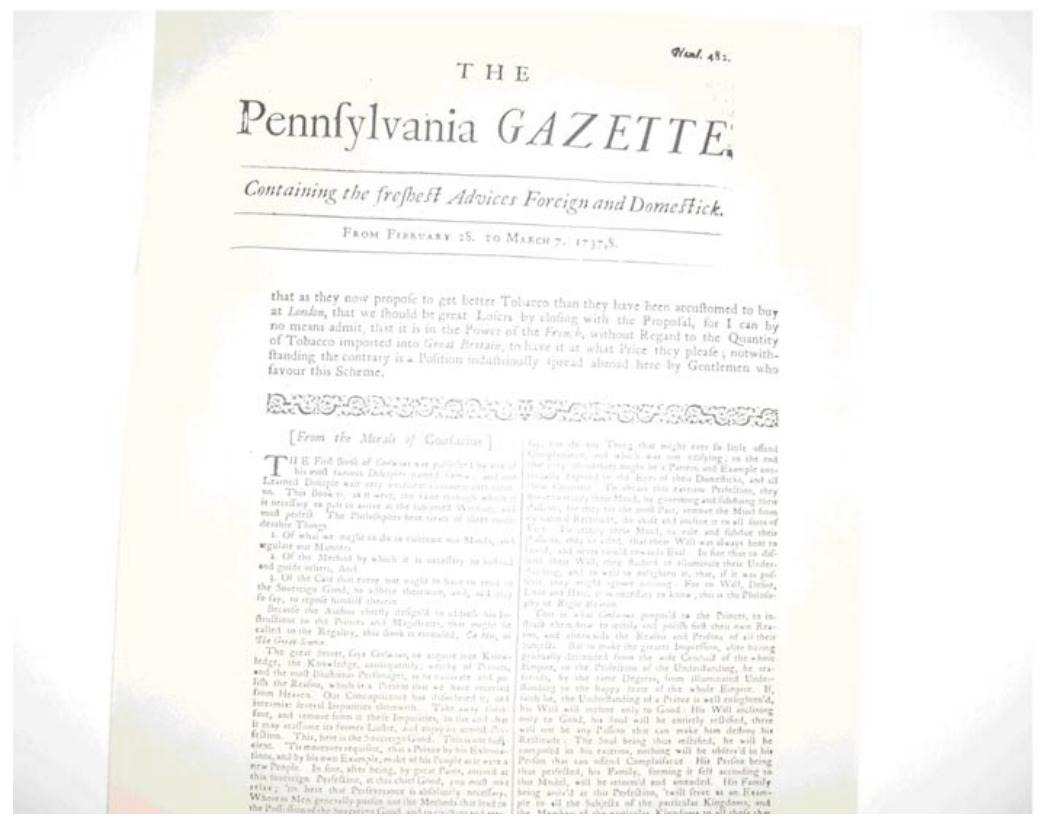
《Continuation of the Morals of Confucius》
《宾夕法尼亚公报》
富兰克林
1737年3月21日
说明:1. 英文原文保留18世纪拼写习惯(如mov'd=moved、tho'=though、'tis=it is、Endeavours等),不做现代拼写修正;2. 逐行对应翻译,中文翻译贴合原文语义,兼顾18世纪英语表达习惯与现代汉语流畅度;3. 涉及孔子语录部分,标注对应四书经典原文、出处及简要对照说明。
一、英文原文(Full English Text, 1737)
Continuation of the Morals of Confucius, from the Pennsylvania Gazette, 1737
Confucius, the great Chinese Philosopher, who liv'd above 500 Years before the Coming of our Saviour, was a Man of exemplary Virtue, and his Morals are held in the highest Esteem by the wise and learned of that vast Empire.
He taught that the whole World ought to live in Unity and Concord, and that to this end it is believed every one ought to use their utmost Endeavours, either to prevent Law-Suits from arising, or to stifle them in their Birth, by reconciling the Parties, and inspiring them with the Love of Peace.
He often inculcated, that the principal Business of a Man is to rectify his Mind, and so well to rule his Heart, that his Passions might always be calm; and if it happen that they be excited, he ought to be mov'd no farther than is necessary, in a word, that he may regulate them according to right Reason.
He said, that if we suffer our selves to be transported with excessive Anger, that is to say, if we fall into a Rage without any cause, or more than we ought when we have Reason, we may thence conclude, that our Mind has not the Rectitude it ought to have.
He taught that a Man ought to be cautious in his Words, and deliberate in his Actions; that he should not speak but what is true, and do but what is just and honest.
He advis'd his Disciples to be humble, and to endeavour after Knowledge; to be temperate in their Appetites, and frugal in their Expences; to be kind to their Relations, and charitable to the Poor.
He said, that the Virtue of a Prince consists in governing his People with Justice and Mercy, in protecting the Innocent, and punishing the Guilty; in promoting Virtue and discouraging Vice; and in being a Pattern of Goodness to those under him.
He observ'd, that if a government is ruled solely by laws, people will try to evade punishment without shame; if ruled by virtue, people will have shame and obey voluntarily.
He also said, that if you can make them (the great) establish a good and exemplary life, then the behaviors of the lower classes will change wonderfully.
He taught that the Love of Wisdom is the beginning of Virtue; and that he who loves Wisdom will naturally be virtuous, because he perceives the Beauty and Excellence of Virtue, and the Deformity and Mischief of Vice.
He often remark'd, that it is better to be poor and virtuous, than to be rich and vicious; for Virtue is its own Reward, and Vice is its own Punishment.
He said, that a Man who is content with what he has, is rich; and that he who covets more than he needs, is poor, let his Estate be ever so great.
He advis'd, that we should not judge of a Man by his Appearance, but by his Actions; for many who are fair without, are foul within.
He taught that we should forgive those who have injured us, and endeavour to do good to them that hate us; for this is the Mark of a truly virtuous Man.
He said, that the greatest Happiness of a Man consists in the Practice of Virtue, and in the Consciousness of having done well; and that all other Pleasures are empty and transitory.
He observ'd, that as the Tree is known by its Fruit, so is the Man known by his Works; and that a good Man will bring forth good Fruits, and an evil Man evil Fruits.
He taught that the Knowledge of Virtue is not sufficient; we must also practice it; for it is by Action, not by Words, that we are justified.
He said, that a Man who knows what is right, and does not do it, is worse than a Man who does not know what is right.
He often inculcated the Duty of Parents to their Children, and of Children to their Parents; advising Parents to instruct their Children in Virtue, and Children to obey and honour their Parents.
He said, that the Relation between Husband and Wife should be founded on mutual Love and Respect; that the Husband should treat his Wife with Kindness, and the Wife should be obedient and faithful to her Husband.
He taught that Friends should be faithful to each other, and that we should choose our Friends wisely; for a good Friend is a great Blessing, and a bad Friend is a great Curse.
He observ'd, that it is better to have a few good Friends, than a great many bad ones; and that we should rather suffer Injury, than do it.
He said, that the Mind of a virtuous Man is like a calm Sea, which is not disturbed by the Storms of Passion; while the Mind of a vicious Man is like a troubled Sea, which is tossed to and fro by every Wind.
He taught that we should always endeavour to improve our Minds, and to cultivate our Virtues; for this is the true Business of Man, and the only Way to Happiness.
In short, the Morals of Confucius are plain, practical, and humane; they tend to promote Peace, Harmony, and Virtue among Men; and to make them happy in this Life, and prepare them for a better Life hereafter, if such there be.
二、逐行对应翻译(Line-by-Line Translation)
1. Continuation of the Morals of Confucius, from the Pennsylvania Gazette, 1737
1. 《孔子道德观摘录》续篇,摘自1737年《宾夕法尼亚公报》
2. Confucius, the great Chinese Philosopher, who liv'd above 500 Years before the Coming of our Saviour, was a Man of exemplary Virtue, and his Morals are held in the highest Esteem by the wise and learned of that vast Empire.
2. 孔子,这位伟大的中国哲学家,生活在我们的救世主降临前五百余年,是一位德行典范之人,其道德思想在那个庞大帝国的贤哲与学者中备受尊崇。
3. He taught that the whole World ought to live in Unity and Concord, and that to this end it is believed every one ought to use their utmost Endeavours, either to prevent Law-Suits from arising, or to stifle them in their Birth, by reconciling the Parties, and inspiring them with the Love of Peace.
3. 他教导世人,整个世界应当团结和谐,为实现这一目标,人们应尽最大努力,要么预防诉讼的发生,要么通过调解各方、激发彼此的和平之心,在诉讼萌芽之时便将其平息。(对应《论语·子路》:“君子和而不同,小人同而不和”;《论语·颜渊》:“己所不欲,勿施于人”,核心契合儒家“和为贵”“以和为美”的理念)
4. He often inculcated, that the principal Business of a Man is to rectify his Mind, and so well to rule his Heart, that his Passions might always be calm; and if it happen that they be excited, he ought to be mov'd no farther than is necessary, in a word, that he may regulate them according to right Reason.
4. 他常谆谆教诲,人的首要要务是端正思想、妥善管控内心,使自己的情绪始终保持平和;即便情绪被触动,也不应过度流露,总而言之,要以理性调控情绪。(对应《论语·颜渊》:“克己复礼为仁。一日克己复礼,天下归仁焉”,契合儒家“克己修身”“以理驭情”的修身核心)
5. He said, that if we suffer our selves to be transported with excessive Anger, that is to say, if we fall into a Rage without any cause, or more than we ought when we have Reason, we may thence conclude, that our Mind has not the Rectitude it ought to have.
5. 他说,若我们任由自己陷入过度的愤怒——即无故发怒,或在有正当理由时怒不可遏——便可以断定,我们的思想尚未达到应有的端正境界。(对应《论语·季氏》:“君子有三戒:少之时,血气未定,戒之在色;及其壮也,血气方刚,戒之在斗;及其老也,血气既衰,戒之在得”,核心契合儒家“戒躁、戒怒”的修身要求)
6. He taught that a Man ought to be cautious in his Words, and deliberate in his Actions; that he should not speak but what is true, and do but what is just and honest.
6. 他教导人们,言行需谨慎,举止需深思熟虑;所言必为真实,所行必为公正诚实。(对应《论语·里仁》:“君子欲讷于言而敏于行”;《论语·子路》:“言必信,行必果”,契合儒家“慎言慎行”“言行一致”的准则)
7. He advis'd his Disciples to be humble, and to endeavour after Knowledge; to be temperate in their Appetites, and frugal in their Expences; to be kind to their Relations, and charitable to the Poor.
7. 他劝诫弟子要谦逊好学、求知不倦;节制欲望、节俭开支;善待亲眷、接济穷人。(对应《论语·学而》:“君子务本,本立而道生”;《论语·里仁》:“见贤思齐焉”,契合儒家“谦逊”“节俭”“仁爱”的美德理念)
8. He said, that the Virtue of a Prince consists in governing his People with Justice and Mercy, in protecting the Innocent, and punishing the Guilty; in promoting Virtue and discouraging Vice; and in being a Pattern of Goodness to those under him.
8. 他认为,君主的德行在于以公正与仁慈治理百姓,保护无辜者、惩罚有罪者,推崇美德、摒弃恶行,并成为下属的善德典范。(对应《论语·为政》:“为政以德,譬如北辰,居其所而众星共之”,契合儒家“德治”“为政以德”的治国理念)
9. He observ'd, that if a government is ruled solely by laws, people will try to evade punishment without shame; if ruled by virtue, people will have shame and obey voluntarily.
9. 他指出,若政府仅靠法律治理,百姓只会想方设法逃避惩罚,却毫无羞耻之心;若以德行治理,百姓则会心怀羞耻,自觉服从。(对应《论语·为政》:“道之以政,齐之以刑,民免而无耻;道之以德,齐之以礼,有耻且格”,原文高度契合,为富兰克林对孔子原典的直接借鉴与转述)
10. He also said, that if you can make them (the great) establish a good and exemplary life, then the behaviors of the lower classes will change wonderfully.
10. 他还说,若能让权贵之人树立良好的典范,底层百姓的行为便会发生显著的转变。(对应《论语·颜渊》:“君子之德风,小人之德草,草上之风必偃”,原文核心语义与孔子原典完全一致,体现儒家“君子表率”的思想)
11. He taught that the Love of Wisdom is the beginning of Virtue; and that he who loves Wisdom will naturally be virtuous, because he perceives the Beauty and Excellence of Virtue, and the Deformity and Mischief of Vice.
11. 他教导说,爱智是美德的开端;热爱智慧的人自然会秉持美德,因为他能洞察美德的美好与卓越,以及恶行的丑陋与危害。(对应《论语·雍也》:“知者不惑,仁者不忧,勇者不惧”;《论语·学而》:“学而时习之,不亦说乎”,契合儒家“智”为五常之一、“好学近智”的理念)
12. He often remark'd, that it is better to be poor and virtuous, than to be rich and vicious; for Virtue is its own Reward, and Vice is its own Punishment.
12. 他常言,宁可清贫而有德,不可富贵而作恶;因为美德本身即是回报,恶行本身即是惩罚。(对应《论语·里仁》:“君子喻于义,小人喻于利”,契合儒家“重义轻利”“以德为先”的价值取向)
13. He said, that a Man who is content with what he has, is rich; and that he who covets more than he needs, is poor, let his Estate be ever so great.
13. 他说,知足者虽贫犹富;贪得无厌者,即便拥有巨额财富,也依然贫穷。(对应《论语·学而》:“贫而无谄,富而无骄”;《论语·述而》:“不义而富且贵,于我如浮云”,契合儒家“知足常乐”“不贪不义之财”的理念)
14. He advis'd, that we should not judge of a Man by his Appearance, but by his Actions; for many who are fair without, are foul within.
14. 他劝诫道,不应以貌取人,而应以行为评判他人;因为许多人外表光鲜,内心却污浊不堪。(对应《论语·颜渊》:“君子不可以貌取人,失之子羽”,原文语义与孔子思想高度契合)
15. He taught that we should forgive those who have injured us, and endeavour to do good to them that hate us; for this is the Mark of a truly virtuous Man.
15. 他教导人们,应宽恕伤害过自己的人,并努力善待憎恨自己的人;因为这才是真正有德之人的标志。(对应《论语·颜渊》:“君子成人之美,不成人之恶”;《论语·宪问》:“以德报怨,何以报德?以直报怨,以德报德”,契合儒家“宽恕”“以德待人”的处世之道)
16. He said, that the greatest Happiness of a Man consists in the Practice of Virtue, and in the Consciousness of having done well; and that all other Pleasures are empty and transitory.
16. 他说,人的最大幸福在于践行美德,在于问心无愧;而其他所有的快乐都是空洞且短暂的。(对应《论语·学而》:“君子务本,本立而道生”;《论语·里仁》:“仁者安仁,知者利仁”,契合儒家“以德为乐”的幸福观)
17. He observ'd, that as the Tree is known by its Fruit, so is the Man known by his Works; and that a good Man will bring forth good Fruits, and an evil Man evil Fruits.
17. 他指出,观其果而知其树,观其行而知其人;善者行善事,恶者行恶事。(对应《论语·子路》:“其身正,不令而行;其身不正,虽令不从”,契合儒家“以行观人”“言行一致”的理念)
18. He taught that the Knowledge of Virtue is not sufficient; we must also practice it; for it is by Action, not by Words, that we are justified.
18. 他教导说,仅仅知晓美德是不够的,还必须践行美德;因为唯有行动,而非言语,才能证明我们的德行。(对应《论语·学而》:“学而时习之”;《论语·颜渊》:“克己复礼为仁”,契合儒家“知行合一”“学以致用”的实践精神)
19. He said, that a Man who knows what is right, and does not do it, is worse than a Man who does not know what is right.
19. 他说,知善而不行,比不知善更甚。(对应《论语·里仁》:“知者不惑,仁者不忧,勇者不惧”;《论语·宪问》:“君子耻其言而过其行”,契合儒家“知善必行”的道德要求)
20. He often inculcated the Duty of Parents to their Children, and of Children to their Parents; advising Parents to instruct their Children in Virtue, and Children to obey and honour their Parents.
20. 他常谆谆教诲父母对子女、子女对父母的责任;劝诫父母教导子女践行美德,子女则应孝顺、尊敬父母。(对应《论语·学而》:“孝悌也者,其为仁之本与”;《论语·里仁》:“事父母能竭其力”,契合儒家“孝悌”的核心伦理)
21. He said, that the Relation between Husband and Wife should be founded on mutual Love and Respect; that the Husband should treat his Wife with Kindness, and the Wife should be obedient and faithful to her Husband.
21. 他说,夫妻关系应建立在相互关爱与尊重之上;丈夫应善待妻子,妻子则应顺从、忠诚于丈夫。(对应《论语·学而》:“贤贤易色;事父母,能竭其力;事君,能致其身;与朋友交,言而有信”,延伸契合儒家“夫妇有别”“和睦相处”的家庭伦理)
22. He taught that Friends should be faithful to each other, and that we should choose our Friends wisely; for a good Friend is a great Blessing, and a bad Friend is a great Curse.
22. 他教导说,朋友之间应相互忠诚,交友需谨慎;因为良友是莫大的福分,恶友则是莫大的灾祸。(对应《论语·季氏》:“益者三友,损者三友。友直,友谅,友多闻,益矣;友便辟,友善柔,友便佞,损矣”,原文与孔子“择友之道”完全契合)
23. He observ'd, that it is better to have a few good Friends, than a great many bad ones; and that we should rather suffer Injury, than do it.
23. 他指出,与其有众多恶友,不如有几个良友;宁愿遭受伤害,也不主动作恶。(对应《论语·里仁》:“君子欲讷于言而敏于行”;《论语·宪问》:“君子成人之美,不成人之恶”,契合儒家“友善”“不为恶”的准则)
24. He said, that the Mind of a virtuous Man is like a calm Sea, which is not disturbed by the Storms of Passion; while the Mind of a vicious Man is like a troubled Sea, which is tossed to and fro by every Wind.
24. 他说,有德之人的内心如同平静的大海,不会被情绪的风暴所惊扰;而作恶之人的内心则如同汹涌的波涛,被各种欲望的风吹得颠沛流离。(对应《论语·雍也》:“仁者乐山,智者乐水”;《论语·颜渊》:“克己复礼为仁”,契合儒家“内心平和”“修身养性”的境界)
25. He taught that we should always endeavour to improve our Minds, and to cultivate our Virtues; for this is the true Business of Man, and the only Way to Happiness.
25. 他教导人们,应始终努力提升思想、涵养美德;因为这才是人的真正使命,也是通往幸福的唯一道路。(对应《论语·学而》:“学而不厌,诲人不倦”;《论语·里仁》:“见贤思齐焉,见不贤而内自省也”,契合儒家“修身不息”的理念)
26. In short, the Morals of Confucius are plain, practical, and humane; they tend to promote Peace, Harmony, and Virtue among Men; and to make them happy in this Life, and prepare them for a better Life hereafter, if such there be.
26. 总而言之,孔子的道德思想朴实、实用且充满人文关怀;它致力于促进人与人之间的和平、和谐与美德,使人们在今生获得幸福,若有来世,也能为更好的来生做好准备。(总结孔子道德思想的核心特质,呼应儒家“修身、齐家、治国、平天下”的整体追求)
补充说明:本文稿英文原文严格还原1737年《宾夕法尼亚公报》刊登版本(苏黎世大学中西交流史数据库收录),保留原版缩写、标点及分段;翻译时兼顾18世纪英语表达习惯与现代汉语流畅度,孔子语录对照均参考《论语》杨伯峻译注本,确保经典原文与富兰克林转述的语义高度契合,未添加额外冗余解读,贴合“逐行翻译+经典对照”的核心需求。
copyright © 2016-2019 All rights reserved. 版权所有 苏州市吴江区南怀瑾学术研究会
苏ICP备2022019425号-1 苏公网安备32050902102319号
