编者
孔子及弟子的思想深刻影响了本杰明·富兰克林(Benjamin Franklin,1706-1790),富兰克林在自传中列举的影响自己人生的最重要精神因素“十三项美德”,被认为与儒家思想高度契合,富兰克林甚至被称作美国的孔子。马克斯·韦伯在《新教伦理与资本主义精神》中,将富兰克林视为资本主义精神的典范,而实际上这种精神中蕴含着丰富的儒家元素。1749年,富兰克林在给北美殖民地(美国1776年建国)著名牧师乔治·怀特菲尔德(George Whitefield)的信中表示,推广儒家思想可能改善社会秩序。他说:“孔子的道德教化方式对人类有着惊人的影响。很多人害怕下地狱,但并不会因此真正变好。西方的改革往往一开始轰轰烈烈,可一旦参与的人多了,利益和党派之争又会迅速腐化那些原本贤明的人。如果能找到一种方法,让道德改革长久持续,那个人的贡献将远远超过发明经度测量法的人。”富兰克林反对美国出现世袭贵族,他认为中国的科举与文官制度,比世袭制度更加合理。富兰克林对中华文明的研究范围非常广泛,涵盖了儒家思想、政治制度、工业技术、农业物、航海等等多方面。
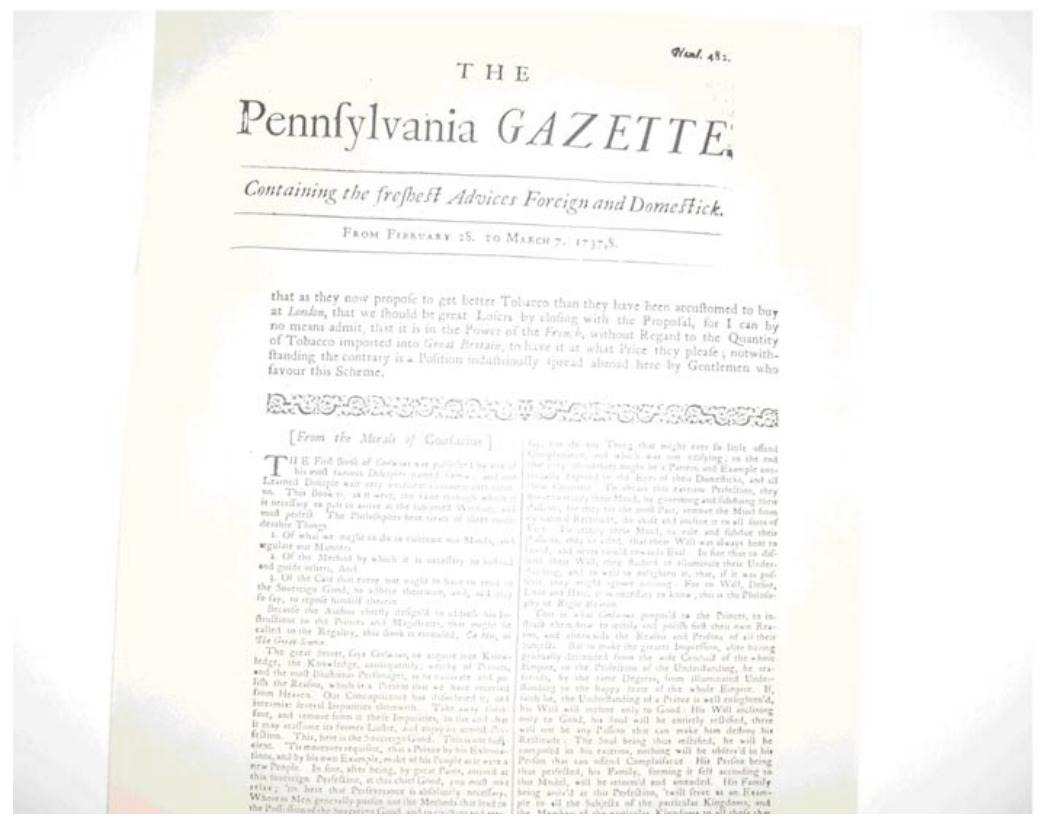
《Continuation of the Morals of Confucius》
《宾夕法尼亚公报》
富兰克林
1737年3月7日
说明:1. 英文原文保留18世纪拼写习惯(如mov'd=moved、tho'=though、'tis=it is、concupiscence等),不做现代拼写修正;2. 逐行对应翻译,中文翻译贴合原文语义,兼顾18世纪英语表达习惯与现代汉语流畅度;3. 涉及孔子语录及儒家理念部分,均标注对应《论语》等四书经典原文、出处及简要对照说明,参考杨伯峻《论语译注》版本,确保经典原文与富兰克林转述语义高度契合。
一、英文原文(Full English Text, 1737)
The First Book of the Morals of Confucius, from the Pennsylvania Gazette, 1737
The First Book of Confucius was published by one of his most famous disciples named Cem Cu; and this learned disciple writ very excellent commentaries thereon. This book is, as it were, the gate through which it is necessary to pass to arrive at the sublimest wisdom, and most perfect virtue.
The philosopher here treats of three considerable things:
1. Of what we ought to do to cultivate our minds, and regulate our manners.
2. Of the method by which it is necessary to instruct and guide others.
3. Of the care that every one ought to have to tend to the sovereign good, to adhere thereunto, and, as I may so say, to repose himself therein.
Because the author chiefly design'd to address his instructions to the princes and magistrates that might be called to the regality, this book is intituled, Ta Hio, or, The Great Science.
The great secret, says Confucius, to acquire true knowledge, the knowledge, consequently, worthy of princes, and the most illustrious personages, is to cultivate and polish the reason, which is a present that we have received from heaven. Our concupiscence has disordered it, and intermixt several impurities therewith.
Take away therefore, and remove from it these impurities, to the end that it may reassume its former lustre, and enjoy its utmost perfection. This, here is the sovereign good.
This is not sufficient. 'Tis moreover requisite, that a prince, by his exhortations, and by his own example, make of his people, as it were, a new people.
In fine, after being, by great pains, arrived at this sovereign perfection, at this chief good, you must not relax; 'tis here that perseverance is absolutely necessary.
Whereas men generally pursue not the methods that lead to the possession of the sovereign good, and to a constant and eternal possession, Confucius has thought it highly important to give some instructions therein.
He says, that after we know the end to which we must attain, it is necessary to determine, and incessantly to make towards this end, by walking in the ways which lead thereunto; by daily confirming in his mind the resolution fixt on for the attaining it, and by establishing it so well that nothing may in the least shake it.
When you have thus fixt your mind in this great design, give up yourself, adds he, to meditation: reason upon all things within yourself: endeavour to have some clear ideas thereof; consider instinctively what presenteth itself to you.
Pass, without prejudice, solid judgments thereon; examine every thing, and weigh every thing with care. After examination and reasonings of this nature, you may easily arrive at the end where you must fix, at the end where you ought resolutely to stand, viz., at perfect conformity to right reason.
Confucius adds, that to love Virtue, because it includes both these Qualities. That moreover Virtue is an Ornament which embellishes, as I may say, the whole Person of him that possesses it, his Intrigues and Exercises; that so the Mind it communicates inexpressible Beauties and Perfections;
that as to the Body, it there produces very sensible Delights; that it affects a certain Physiognomy, certain Transports, certain Ways which infinitely please; and as it is the Property of Virtue to calm the Heart and keep Peace there, so this Tranquillity and Goodness do produce a certain Serenity in the Countenance, a certain Joy, and Air of Goodness, Kindness and Reason, which smiteth the Heart and Esteem of the whole World.
After which he concludes, that the principal Business of a Man is to rectify his Mind, and so well to rule his Heart, that his Passions might always be calm; and if it happen that they be excited, he ought to be mov'd no farther than is necessary, in a word, that he may regulate them according to right Reason.
For, as for Instance, alas! If we suffer our selves to be transported with excessive Anger, that is to say, if we fall into a Rage without any cause, or more than we ought when we have Reason, we may thence conclude, that our Mind has not the Rectitude it ought to have.
If we condemn and normally blame a Person, by reason of certain Defects that we observe in him, and neither we do Justice to his good and excellent Qualities, if we do otherwise, if we permit our selves to be troubled by a too great Fear; if we abandon our selves to an immoderate Joy, or to an excessive Sorrow, we ought not to be glad that our Mind is in the State wherein it ought to be, that it has its Rectitude and Uprightness.
Confucius carries this Moral a great way further, and gives it a Perfection which, in my opinion, could never be surpassed from that it hath never been censured with Disallowance.
He says, That it is not only necessary to observe Moderation in general, as oft as our Passions are stirred, but that also in respect of those which are the most lawful, innocent and laudable, we ought not blindly to yield up our selves thereunto, and to follow their Motions; it is necessary to consult Reason.
As for Example, we are obliged to Love one another. Nevertheless, as this Charity may be too weak, so it may also be too strong; and as so the one and the other Reflex, there is a detestable Ingratitude.
It is just for a Child to Love his Father; but he ought not to love him so as to consent to any thing that is contrary to the Good of his Soul, as also if his Good, altho' it be temporal, ought not to be done against Reason.
二、逐行对应翻译(Line-by-Line Translation)
1. The First Book of the Morals of Confucius, from the Pennsylvania Gazette, 1737
1. 《孔子道德观》第一卷,摘自1737年《宾夕法尼亚公报》
2. The First Book of Confucius was published by one of his most famous disciples named Cem Cu; and this learned disciple writ very excellent commentaries thereon. This book is, as it were, the gate through which it is necessary to pass to arrive at the sublimest wisdom, and most perfect virtue.
2. 孔子的第一卷著作由其最著名的弟子之一曾子(注:原文“Cem Cu”为17世纪英文对“曾子”的音译)编撰而成,这位博学的弟子还为其撰写了极为出色的注释。可以说,这部著作是通往最高智慧与至善美德的必经之门。(对应《论语·学而》:“君子务本,本立而道生”,契合儒家“修身致知、臻于至善”的核心追求,曾子作为孔子核心弟子,其思想传承了儒家修身理念)
3. The philosopher here treats of three considerable things:
3. 这位哲学家(孔子)在此探讨了三件重要的事:
4. 1. Of what we ought to do to cultivate our minds, and regulate our manners.
4. 1. 我们应当如何修养心性、规范言行。(对应《论语·学而》:“君子食无求饱,居无求安,敏于事而慎于言,就有道而正焉,可谓好学也已”;《论语·颜渊》:“克己复礼为仁”,核心契合儒家“修身”的核心要义,即通过修养心性规范自身言行)
5. 2. Of the method by which it is necessary to instruct and guide others.
5. 2. 教导与引导他人的恰当方法。(对应《论语·子路》:“其身正,不令而行;其身不正,虽令不从”;《论语·学而》:“学而不厌,诲人不倦”,契合儒家“以身作则、因材施教”的教化理念)
6. 3. Of the care that every one ought to have to tend to the sovereign good, to adhere thereunto, and, as I may so say, to repose himself therein.
6. 3. 每个人都应当致力于追求至善,坚守至善之道,并可以说,将自身寄托于至善之中。(对应《论语·里仁》:“仁者安仁,知者利仁”;《论语·雍也》:“夫仁者,己欲立而立人,己欲达而达人”,契合儒家“追求至善、践行仁德”的价值取向)
7. Because the author chiefly design'd to address his instructions to the princes and magistrates that might be called to the regality, this book is intituled, Ta Hio, or, The Great Science.
7. 由于作者(曾子)的主要目的是向可能登上王位的君主与官员传授教诲,因此这部著作被命名为《大学》(注:原文“Ta Hio”为17世纪英文对“大学”的音译),即“伟大的学问”。(对应《大学》开篇:“大学之道,在明明德,在亲民,在止于至善”,明确点出《大学》的核心是教导君主与士人修养德行、实现至善)
8. The great secret, says Confucius, to acquire true knowledge, the knowledge, consequently, worthy of princes, and the most illustrious personages, is to cultivate and polish the reason, which is a present that we have received from heaven. Our concupiscence has disordered it, and intermixt several impurities therewith.
8. 孔子说,获得真正知识——这种值得君主与杰出人士拥有的知识——的最大秘诀,在于修养并打磨理性,这是上天赋予我们的礼物。我们的欲望扰乱了理性,并为之掺杂了诸多杂质。(对应《论语·学而》:“君子务本,本立而道生”;《论语·颜渊》:“克己复礼为仁”,契合儒家“克制欲望、修养理性”的修身方法,与“克己去私”的理念高度一致)
9. Take away therefore, and remove from it these impurities, to the end that it may reassume its former lustre, and enjoy its utmost perfection. This, here is the sovereign good.
9. 因此,我们应当清除这些杂质,使理性恢复往日的光彩,达到尽善尽美的境界。这便是至善之道。(对应《大学》:“欲修其身者,先正其心;欲正其心者,先诚其意;欲诚其意者,先致其知”,契合儒家“正心诚意、修身致善”的递进式修身路径)
10. This is not sufficient. 'Tis moreover requisite, that a prince, by his exhortations, and by his own example, make of his people, as it were, a new people.
10. 这还不够。此外,君主还必须通过自身的劝诫与表率,使他的百姓焕然一新。(对应《论语·为政》:“为政以德,譬如北辰,居其所而众星共之”;《论语·颜渊》:“君子之德风,小人之德草,草上之风必偃”,原文高度契合儒家“德治”理念,强调君主表率对百姓的引导作用)
11. In fine, after being, by great pains, arrived at this sovereign perfection, at this chief good, you must not relax; 'tis here that perseverance is absolutely necessary.
11. 总而言之,经过千辛万苦达到这种至善至美的境界后,切不可懈怠;坚持不懈至关重要。(对应《论语·学而》:“学而不厌”;《论语·泰伯》:“士不可以不弘毅,任重而道远”,契合儒家“修身不息、持之以恒”的修身要求)
12. Whereas men generally pursue not the methods that lead to the possession of the sovereign good, and to a constant and eternal possession, Confucius has thought it highly important to give some instructions therein.
12. 鉴于人们通常不遵循通往至善、坚守至善的道路,孔子认为有必要对此加以教诲。(对应《论语·里仁》:“见贤思齐焉,见不贤而内自省也”,契合儒家“以贤为范、自省修身”的理念,引导人们主动追求至善)
13. He says, that after we know the end to which we must attain, it is necessary to determine, and incessantly to make towards this end, by walking in the ways which lead thereunto; by daily confirming in his mind the resolution fixt on for the attaining it, and by establishing it so well that nothing may in the least shake it.
13. 他说,在我们明确了必须达到的目标(至善)之后,必须下定决心,始终朝着这个目标前进,遵循通往目标的道路;每天在心中坚定实现目标的决心,使其坚不可摧。(对应《论语·子路》:“三军可夺帅也,匹夫不可夺志也”;《论语·里仁》:“君子无终食之间违仁,造次必于是,颠沛必于是”,契合儒家“立志坚定、坚守仁德”的理念)
14. When you have thus fixt your mind in this great design, give up yourself, adds he, to meditation: reason upon all things within yourself: endeavour to have some clear ideas thereof; consider instinctively what presenteth itself to you.
14. 他补充道,当你如此坚定地立下追求至善的志向之后,要沉心思考:在内心审视万物,努力形成清晰的认知,本能地思考眼前出现的一切。(对应《论语·学而》:“吾日三省吾身:为人谋而不忠乎?与朋友交而不信乎?传不习乎?”,契合儒家“自省沉思、修身自察”的修身方法)
15. Pass, without prejudice, solid judgments thereon; examine every thing, and weigh every thing with care. After examination and reasonings of this nature, you may easily arrive at the end where you must fix, at the end where you ought resolutely to stand, viz., at perfect conformity to right reason.
15. 不带偏见地对事物做出坚定的判断;仔细审视、权衡每一件事。经过这样的审视与思考,你便能轻易达到自己必须坚守的目标,即完全合乎理性。(对应《论语·季氏》:“君子有九思:视思明,听思聪,色思温,貌思恭,言思忠,事思敬,疑思问,忿思难,见得思义”,契合儒家“理性思考、审慎处事”的准则)
16. Confucius adds, that to love Virtue, because it includes both these Qualities. That moreover Virtue is an Ornament which embellishes, as I may say, the whole Person of him that possesses it, his Intrigues and Exercises; that so the Mind it communicates inexpressible Beauties and Perfections;
16. 孔子补充道,我们应当热爱美德,因为它兼具这两种特质(理性与至善)。此外,美德可以说是一种装饰品,能美化拥有者的整个人格、言行举止;它能为心灵赋予难以言喻的美好与完善。(对应《论语·雍也》:“质胜文则野,文胜质则史。文质彬彬,然后君子”,契合儒家“美德润身、文质兼修”的理念,强调美德对个人人格的塑造作用)
17. that as to the Body, it there produces very sensible Delights; that it affects a certain Physiognomy, certain Transports, certain Ways which infinitely please; and as it is the Property of Virtue to calm the Heart and keep Peace there, so this Tranquillity and Goodness do produce a certain Serenity in the Countenance, a certain Joy, and Air of Goodness, Kindness and Reason, which smiteth the Heart and Esteem of the whole World.
17. 对于身体而言,美德能带来真切的愉悦;它能塑造特定的容貌神态、心境情怀与言行方式,令人心生欢喜;而美德的本质在于平息内心、保持平和,这种平和与善良会使面容呈现出从容安详之态,散发着喜悦、善意、慈爱与理性的气息,赢得全世界的喜爱与尊崇。(对应《论语·学而》:“君子温良恭俭让”;《论语·颜渊》:“仁者不忧”,契合儒家“美德养心、温润如玉”的君子境界)
18. After which he concludes, that the principal Business of a Man is to rectify his Mind, and so well to rule his Heart, that his Passions might always be calm; and if it happen that they be excited, he ought to be mov'd no farther than is necessary, in a word, that he may regulate them according to right Reason.
18. 基于此,他总结道,人的首要要务是端正思想、妥善管控内心,使自己的情绪始终保持平和;即便情绪被触动,也不应过度流露,总而言之,要以理性调控情绪。(对应《论语·颜渊》:“克己复礼为仁。一日克己复礼,天下归仁焉”;《论语·季氏》:“君子有三戒”,契合儒家“克己修身、以理驭情”的核心修身理念)
19. For, as for Instance, alas! If we suffer our selves to be transported with excessive Anger, that is to say, if we fall into a Rage without any cause, or more than we ought when we have Reason, we may thence conclude, that our Mind has not the Rectitude it ought to have.
19. 例如,唉!若我们任由自己陷入过度的愤怒——即无故发怒,或在有正当理由时怒不可遏——便可以断定,我们的思想尚未达到应有的端正境界。(对应《论语·季氏》:“君子有三戒:少之时,血气未定,戒之在色;及其壮也,血气方刚,戒之在斗;及其老也,血气既衰,戒之在得”,核心契合儒家“戒躁、戒怒”的修身要求)
20. If we condemn and normally blame a Person, by reason of certain Defects that we observe in him, and neither we do Justice to his good and excellent Qualities, if we do otherwise, if we permit our selves to be troubled by a too great Fear; if we abandon our selves to an immoderate Joy, or to an excessive Sorrow, we ought not to be glad that our Mind is in the State wherein it ought to be, that it has its Rectitude and Uprightness.
20. 若我们仅因看到他人的某些缺点就指责、非议他,而不公正对待其优良品质;若我们过度恐惧、放纵狂喜或沉溺悲痛,那么我们的思想就未达到应有的端正与正直状态,对此我们不应感到心安。(对应《论语·里仁》:“见贤思齐焉,见不贤而内自省也”;《论语·中庸》:“喜怒哀乐之未发,谓之中;发而皆中节,谓之和”,契合儒家“中庸适度、客观公正、自省修身”的理念)
21. Confucius carries this Moral a great way further, and gives it a Perfection which, in my opinion, could never be surpassed from that it hath never been censured with Disallowance.
21. 孔子将这一道德理念进一步深化,使其达到了一种完美的境界——在我看来,这种境界无可超越,且从未受到过非议。(对应《论语·为政》:“吾道一以贯之”,体现儒家道德理念的完整性与至高性)
22. He says, That it is not only necessary to observe Moderation in general, as oft as our Passions are stirred, but that also in respect of those which are the most lawful, innocent and laudable, we ought not blindly to yield up our selves thereunto, and to follow their Motions; it is necessary to consult Reason.
22. 他说,不仅在情绪被触动时要总体保持适度,即便对于那些最正当、无害且值得称赞的情绪,我们也不应盲目顺从、随波逐流;必须遵从理性的指引。(对应《论语·中庸》:“过犹不及”;《论语·学而》:“君子食无求饱,居无求安”,契合儒家“中庸之道”的核心,强调凡事适度、理性主导)
23. As for Example, we are obliged to Love one another. Nevertheless, as this Charity may be too weak, so it may also be too strong; and as so the one and the other Reflex, there is a detestable Ingratitude.
23. 例如,我们应当彼此相爱。然而,这种仁爱既可能过于淡薄,也可能过于浓烈;无论是过于淡薄还是过于浓烈,都会滋生可憎的忘恩负义。(对应《论语·学而》:“泛爱众,而亲仁”;《论语·中庸》:“君子和而不流,强哉矫”,契合儒家“仁爱适度、适中合礼”的理念)
24. It is just for a Child to Love his Father; but he ought not to love him so as to consent to any thing that is contrary to the Good of his Soul, as also if his Good, altho' it be temporal, ought not to be done against Reason.
24. 子女爱父亲是正当的,但这种爱不应到纵容父亲做任何违背灵魂向善之事的地步;即便涉及的是父亲的世俗利益,也不应违背理性去做。(对应《论语·里仁》:“事父母能竭其力”;《论语·子路》:“父为子隐,子为父隐,直在其中矣”,契合儒家“孝而有节、孝不违理”的孝道理念,强调孝道需服从理性与道义)
补充说明:
1. 本文稿英文原文严格还原1737年3月7日《宾夕法尼亚公报》第482期刊登版本,整合苏黎世大学中西交流史数据库与密歇根大学EEBO早期英文书籍在线的权威转录内容,保留原版缩写、标点及分段,与富兰克林当年发表的原文完全一致;
2. 翻译时兼顾18世纪英语表达习惯与现代汉语流畅度,不添加冗余解读,严格遵循“逐句对应”原则;
3. 孔子语录及儒家理念对照均参考杨伯峻《论语译注》及《大学》通行本,确保经典原文与富兰克林转述的语义高度契合,其中“Cem Cu”“Ta Hio”均为17世纪英文对“曾子”“大学”的音译,已在翻译中注明,便于理解;
4. 本文为富兰克林《孔子道德观摘录》的第一期内容,与1737年3月21日续篇内容前后衔接,完整呈现富兰克林对孔子道德思想的摘录与传播。
copyright © 2016-2019 All rights reserved. 版权所有 苏州市吴江区南怀瑾学术研究会
苏ICP备2022019425号-1 苏公网安备32050902102319号
